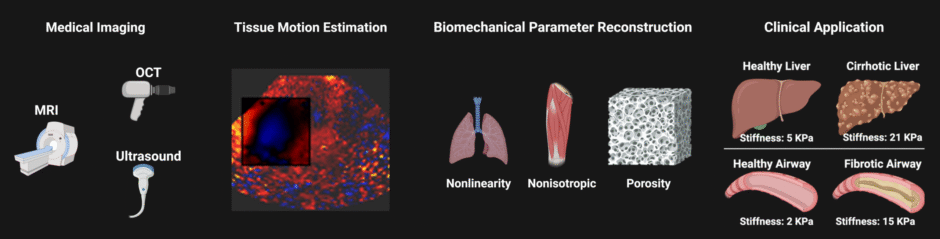
The Biomechanical Imaging and Computation Lab develops tools for multi-parameter and multiscale mapping of tissue mechanical environment for early detection of fibrosis and cancer, as well as advancement of our understanding of the interaction between pathology and its biomechanical environment. Our work covers fundamental and translational research in elastography from macro-scale magnetic resonance elastography/ ultrasound elastography to microscale optical coherence elastography.
We work highly collaboratively at the intersection of engineering, physics, and biology. In short, in our laboratory, we are:
- Developing computational, optimization, and AI-driven algorithms for fast acquisition and reliable reconstruction of elastography for clinical diagnosis
- Developing a multiscale multiparametric elastography system with multimodality imaging to advance understanding of tissue biomechanics and pathogenesis.
- Exploring the possibility of a biomechanics-informed patient-specific digital twin for health management
- Translating elastography techniques to new clinical applications in pulmonary, hepatology, urology, cardiology, and reproductive medicine.
We welcome graduate and undergraduate students interested in our work to join our lab. We are open to collaborations with other labs in Charlotte and North Carolina! Please reach out if you are interested in applying elastography in cancer and fibrosis detection, advanced dynamic imaging and reconstruction in medical imaging, or understanding the interplay between pathogenesis and biomechanics from an engineering perspective.
Open Position
We are currently seeking one PhD student to join the Biomechanical Imaging and Computation Lab at the University of North Carolina, Charlotte, starting in Fall 2026. These positions come with full funding support.
Research Areas: Medical imaging (e.g., optical coherence tomography, ultrasound, MRI), Medical Image Reconstruction, AI, Physics Informed Neural Network
The ideal student should have a mix of experience and skills in at least two of the following areas:
- Signals and systems / linear systems
- Optimization and inverse problems
- Scientific computing (Python / MATLAB)
- Machine learning / deep learning (PyTorch preferred)
- Medical imaging (OCT, MRI, ultrasound)
- Numerical modeling (finite elements, PDE-based modeling)
The projects are primarily within the Department of Electrical and Computer Engineering at the University of North Carolina at Charlotte. However, students interested in Biomedical Engineering, Applied Physics, or related interdisciplinary areas will also be considered.
If you are interested, please send your CV by email with the subject line “Prospective Graduate Student – [Your Name]”. In your CV, please clearly highlight your experience and skills that match the areas listed above. Thank you for your interest in our research group.
#PhD #ComputationalImaging #OCT #Elastography #InverseProblems #BiomedicalEngineering


